

Schengen EES Update: Guidance for Yacht Crew
16 April 2026
New Schengen Immigration Entry/Exit System (EES) for non-Schengen nationals:
What does it mean for yacht crew?
Date: 15 April 2026
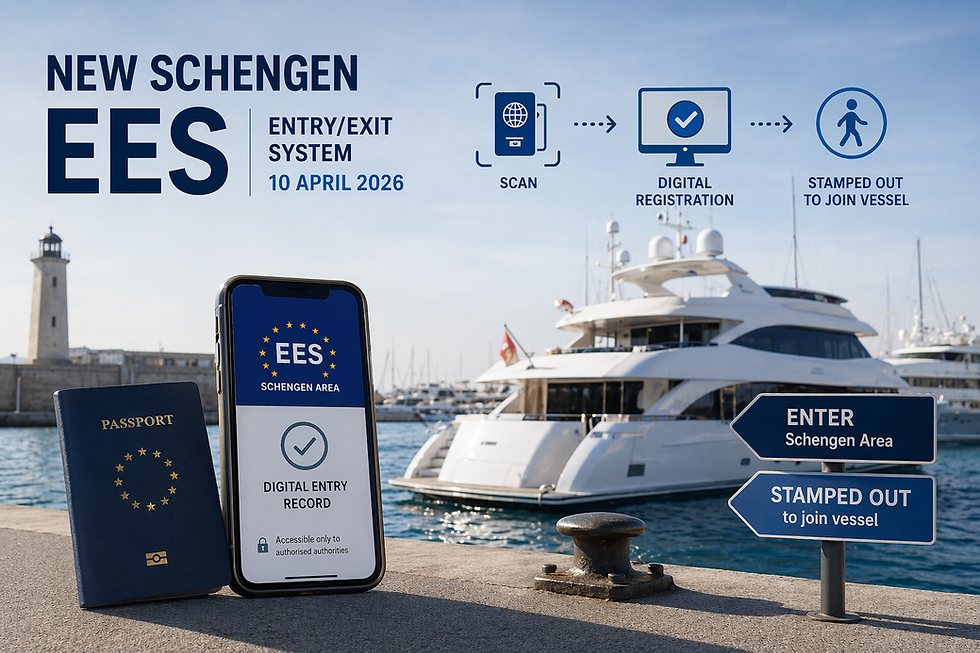
As you may know, the new Schengen Immigration Entry/Exit System (EES) for non-Schengen nationals entered into force on 10 April 2026.
This new digital EES registration replaces the system of manually stamping passports when visitors arrive in the EU. It is a European database in which the Member States record the data of nationals of non-EU and non-Schengen Area countries, who cross the borders into the Schengen Area. It has been gradually implemented since 12 October 2025 and has been "fully" operational since 10 April 2026.
The PYA reached out to EU officials to discuss the situation of non-Schengen nationals joining a vessel in a port in the Schengen Area, and I met with officials from the French Immigration administration, to discuss how the system would be implemented.
In theory, nothing has changed for Non-Schengen nationals, other than the fact that they are digitally stamped in (not in their passport) when they enter a Schengen border and digitally stamped out (not in their passport) when they board their vessel, and vice versa.
Individuals who require a visa will still need a visa and their passport must be valid for at least 3 months beyond the planned end of stay in the Schengen Area.
A new European Travel Information and Authorisation System (ETIAS) for nationals not subject to a visa, will be implemented towards the end of 2026.
The system in practice
From now on, when a non-Schengen national arrives at a Schengen border, their passport will be scanned into the system with the date of entry. The very fact that the immigration officer will let the individual into the Schengen Area, serves as a proof that they are legally allowed to remain in the Schengen Area.
As with the old system, the individual should then go to the immigration office, local to their vessel, to present their passport. It will be scanned again and the immigration officer will make a digital note in the system (not in their passport) that the yacht crew has been “stamped out” to join the vessel.
The reverse should be implemented when the crew leaves the yacht to fly outside the Schengen Area.
A very important matter, with huge consequences, is the fact that only Customs & Immigration and the Border Police have access to the Digital system.
The individual will have no visible proof to show that they are legally in the Schengen Area and within the number of allocated days.
Serious implications
1. The responsibility lies with the crew member, to make sure that they are operating within the confines of the immigration law.
2. They will have no official means to prove the above to the yacht captain or to the management company. This is the reason why we recommend to all non-Schengen nationals to keep a record of their Schengen entry & exit dates (this could be on a loose sheet of paper, copies of their boarding passes and any other means to document their coming in and out of Schengen borders, such as dated photos at airports, etc.).
3. Should a non-Schengen national exceed their number of days in the Schengen area, they may face a number of possibilities:
If trying to be stamped back into the country to leave the boat, the immigration officer is likely to refuse and ask the captain to sail the vessel to a non-Schengen country, in order for the crew member to disembark;
If going straight to the airport or to any other Schengen border to exit, a note will be inserted into their file and this may adversely affect their next attempt to enter the Schengen area. They can be declined re-entry or, at the very least, the individual will have to wait 90 days outside the Schengen Area before they can re-enter for another short stay.
In theory, the above is the way the system should be implemented in the whole of the Schengen area.
The situation in Italy
We understand that Italy is implementing a different procedure than described above, requesting vessels to depart Italian waters within 10 days, in order for crew to be stamped out. We are told by non-Italian officials that this country’s “application of the new EES is not in line with the Schengen Code”.
Food for thought
1. As is often the case, administrations are not best at communicating new regulations. We understand that the information should have been communicated “Top-Down”, from central administrations to regional administrations, then to harbour authorities, etc. We understand from local Immigration officers that not many stakeholders are aware of the workings of the new EES. For this reason, please feel free to distribute this email widely to your own network, management and other companies, other vessels, Harbour masters, etc.
2. As we have seen in the past, crew may face different situations when addressing immigration officials, depending on the port or even sometimes depending on the individual they are addressing. Should crew encounter any problems or issues with the implementation of the new EES, please contact me at ceo@pya.org, as we would like to gather, and document, real-life experience to provide feedback to administrations and to maritime authorities.
Best regards
Christophe Bourillon
CEO, PYA

More news

Sea Changes Forum 2026 highlights - Navigating the future of yachting
The PYA Sea Changes Forum 2026, held on 24 September at the IHO in Monaco, brought together Flag States, maritime authorities and industry experts to address critical yachting updates, safety compliance, crew training and welfare, and ocean stewardship initiatives.

Sea Changes Forum 2026
The PYA is pleased to invite you to the 2026 Sea Changes Forum, taking place on Thursday, 24 September 2026, at the International Hydrographic Organization (IHO) in Monaco, during the Monaco Yacht Show.
.png)
Upcoming Webinar: Water Safety On Yachts
The Professional Yachting Association is pleased to invite yacht crew and industry professionals to an upcoming live webinar dedicated to Water Safety On Yachts, taking place on 10 June 2026 from 15:00 to 16:00CET.
Led by recognised experts in water management and regulatory compliance, this session will explore the common bacteria found in vessel water systems, the risks they pose to crew, guests and operations, and the practical measures that can be implemented to maintain safe onboard water standards.